



Blog
How to Get an Accurate Joinery Quote in Saudi Arabia
Home / Custom Woodwork / How to Get an Accurate Joinery Quote in Saudi Arabia
A joinery quote in Saudi Arabia is only as accurate as the pack you send. Give the manufacturer six things: drawings or measured dimensions, a finish schedule, a hardware specification, site access details, quantities and a target delivery date. Then ask for an itemised quotation with inclusions, exclusions and payment milestones in writing. Two quotes within about 10 percent of each other usually price the same scope.
In this article
- Why is there no single joinery price per square metre?
- What should you send to get a joinery quotation?
- What does a good joinery quotation contain?
- What drives joinery cost in Riyadh?
- What do the inclusion and exclusion words actually mean?
- How do you compare three joinery quotes side by side?
- How are payments usually structured?
- What happens when you change something after signing?
- Is your site ready for joinery installation?
- How does the drawing approval workflow work?
- How does joinery lead time really add up?
- What are the red flags in a joinery quotation?
- What should you ask on a factory visit?
- Is a quote for a contractor different from a quote for a homeowner?
- Kitchen and wardrobe quotation: what to specify for each
If you have collected two or three joinery quotes for the same villa and the totals are far apart, the cheaper one is rarely the better deal and the dearer one is rarely a rip-off. Most of the time the suppliers have priced different jobs: one included installation and the other did not, one assumed 18 mm board and the other 16 mm, one allowed for soft-close runners and the other for plain ones. This guide shows you how to ask for a joinery quote in Saudi Arabia so that the numbers come back comparable, and how to read them when they do. It is written for villa owners, contractors and developers who are working with a custom joinery manufacturer in Riyadh or elsewhere in the Kingdom. NBELCO quotes per project and does not publish rates, so you will find no prices here, only the method.
Why is there no single joinery price per square metre?
People searching for joinery price per square metre usually want a number to sanity-check a quote. The trouble is that a square metre of wardrobe front and a square metre of a curved reception counter are different products. The first is mostly flat panels, repeated hinges and a standard carcass. The second may need CNC cutting, bent or segmented components, hand finishing and a site visit just to template it. Even two flat wardrobes of identical area can differ by a wide margin once you change the board, the face finish, the hardware or the number of internal drawers.
A per-square-metre rate can be useful inside one supplier's own price list, where scope and specification are fixed. Across suppliers it hides everything that matters. So instead of asking what the rate is, ask these questions:
- What board, thickness and edge treatment is this price based on?
- Which hinge and runner brand and tier, and are soft-close mechanisms in the price?
- How many coats and which finish system on painted or lacquered parts?
- Is the price for supply only, supply and delivery, or supply, delivery and installation?
- What assumptions did you make about the site, for example lift access or floor level?
If a supplier cannot answer those five, the rate they quoted is not worth comparing.
What should you send to get a joinery quotation?
The fastest way to an accurate quote is a complete request pack. Suppliers do not slow down because they are lazy; they slow down because they have to phone you for the missing items, and each round of questions can cost a day or two. Send this once and most suppliers can price without a second call.
| Item in the pack | What it should contain | What goes wrong without it |
|---|---|---|
| Drawings or dimensions | Architect plans with joinery marked, or a sketch with length, height and depth per wall in cm, plus door and window positions | The supplier guesses board quantity and unit splits, then corrects the price after the survey |
| Design references | Two or three photos of the look you want, and one of what you do not want | The quote covers a plain version of the unit and the detailed version arrives later as a variation |
| Finish schedule | Laminate, veneer, lacquer or paint, with colour or code, matt or gloss, which faces are finished | Finish is the largest swing in price, so a vague finish makes the quote unreliable |
| Hardware specification | Hinge and runner type, handle style, soft-close or push-to-open, any lifting systems | Hardware gets downgraded quietly, and you notice it a year later |
| Quantities | Number of identical rooms, units or apartments | Repeat units are cheaper per unit, but only if the supplier knows about them at the start |
| Site details | District, building type, floor, lift size, parking, work-hours rules, readiness of walls and floors | Installation is priced on guesswork and returns as a surcharge |
| Target dates | Required delivery or handover date and how firm it is | The supplier quotes a lead time that does not fit, or you discover it after signing |
| Contact and approver | Who signs drawings and who pays | Approvals stall because the person approving was never named |
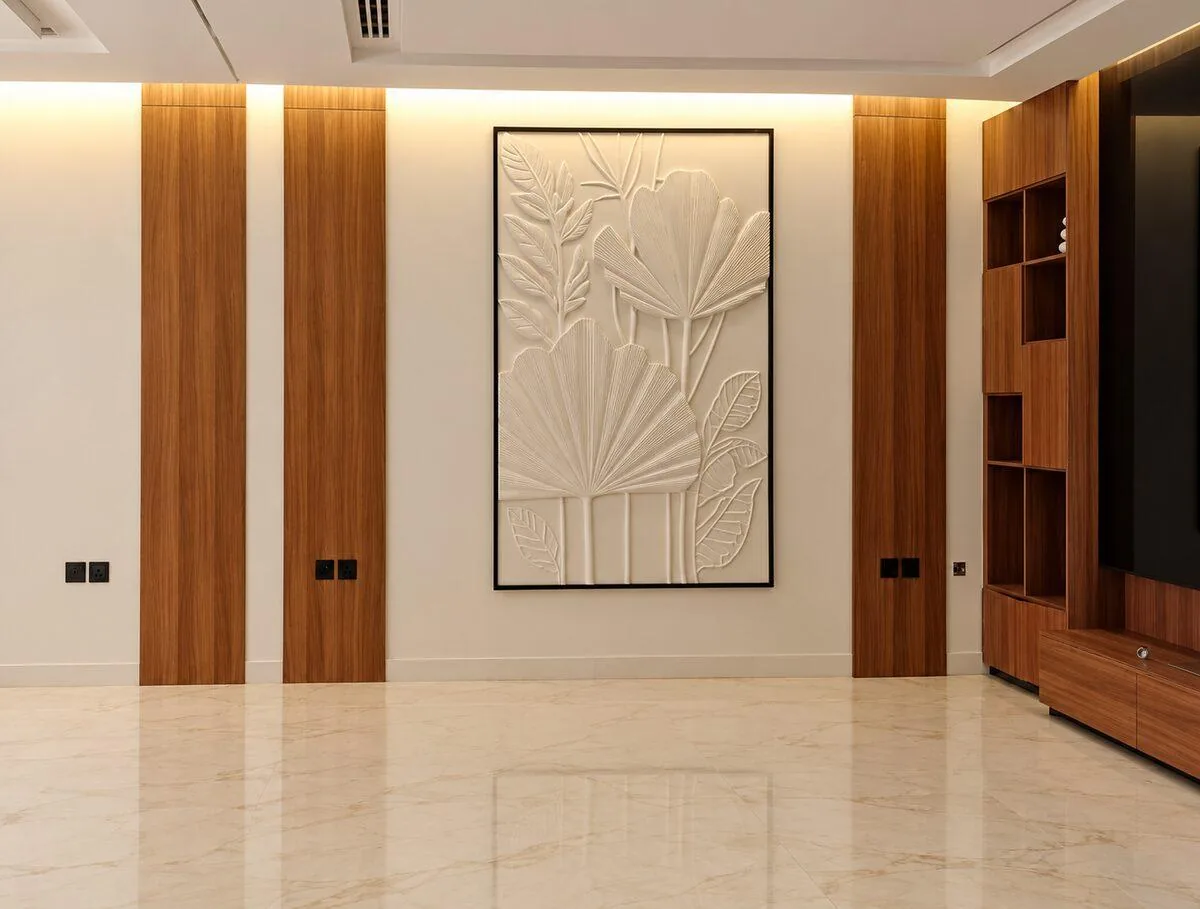
A note on drawings. If you only have a floor plan, say so. A good joinery contractor in Saudi Arabia would rather visit the site and measure than price from a plan that was drawn before the blockwork was finished. Finished walls are rarely perfectly square or plumb, and a kitchen that was drawn at 3,200 mm may measure 3,170 mm at one end and 3,215 mm at the other. Those differences are small but they decide where the filler panels go.
What does a good joinery quotation contain?
A quotation that fits on one page with a single lump sum is a budget, not a quote. You want a document you could hand to a stranger who then builds the same thing. The sections below are what to look for, and the table after them is a line-item layout you can ask suppliers to follow.
- Itemised scope. Every unit or area on its own line, with dimensions, so a missing wardrobe is obvious.
- Board type, thickness, core and face finish for the carcass, the doors and the visible ends, because these are often three different materials.
- Hardware named by type and brand tier, with quantities per unit.
- What is included: survey, shop drawings, manufacture, packing, delivery, installation, silicone and sealing, adjustment after installation.
- What is excluded: electrical and plumbing, counter-top stone, appliances, removal of old units, wall repairs, builder's cleaning, parking fees.
- Programme counted from signed drawings, not from the date you called.
- Payment milestones tied to events, not to calendar dates.
- Warranty wording: which parts, for how long, what voids it, and who attends.
- Validity of the quote, because board and hardware prices move.
A line-item layout to ask for
This is a simplified bill of quantities for joinery. The blank columns are the ones suppliers most often leave empty or merge into a lump sum; asking for them is how you find out what has not been priced.
| Ref | Item and location | Size (W x H x D, mm) | Qty | Board and finish | Hardware | Install incl.? | Unit price | Line total |
|---|---|---|---|---|---|---|---|---|
| K-01 | Base units, kitchen, run A | 3200 x 870 x 580 | 1 run | |||||
| K-02 | Wall units, kitchen, run A | 3200 x 720 x 330 | 1 run | |||||
| K-03 | Tall pantry unit | 600 x 2300 x 580 | 1 | |||||
| W-01 | Master wardrobe, hinged | 2800 x 2600 x 600 | 1 | |||||
| W-02 | Wardrobe internal drawers | As W-01 | 4 | |||||
| C-01 | Feature wall cladding and TV unit | 4200 x 2800 | 1 | |||||
| S-01 | Survey, shop drawings, samples | n/a | Lot | n/a | n/a | |||
| S-02 | Delivery and installation | n/a | Lot | n/a | n/a |
The dimensions in the table are examples of how to write a line, not recommended sizes. Notice that surveys, drawings and installation have their own lines. When they are buried inside unit prices you cannot tell what you are paying for, and you cannot remove them if you decide to use your own installer.
What drives joinery cost in Riyadh?
Whether you are asking about joinery cost in Riyadh, Jeddah or the Eastern Province, the drivers are the same. The table lists them roughly in order of how much they move a quotation, and what you can do about each.
| Cost driver | Why it moves the price | What you can control |
|---|---|---|
| Face finish | Natural veneer and multi-coat lacquer need more labour, more drying time and more rejects than laminate | Use the premium finish where it is seen, laminate inside |
| Core board and thickness | MDF, moisture-resistant board, plywood and solid wood differ in material cost and in machining | Moisture-resistant core for kitchens and wet rooms; standard core for dry wardrobes |
| Hardware tier | A drawer runner and a hinge are bought hundreds of times in a kitchen, so tier differences multiply | Spend on runners and hinges, save on handles |
| Geometry | Curves, mitres, 45-degree returns, integrated lighting channels and non-standard heights add machine and bench time | Keep modules to board-friendly sizes where the design allows |
| Quantity and repetition | Setup, programming and drawings are spread across identical units | Standardise unit types across rooms |
| Site and access | Stairs without a lift, restricted work hours, long carrying distance and unfinished floors add installation time | Tell the supplier early; prepare the site |
| Programme | Compressed schedules mean overtime, split batches or air-freighted hardware | Order early, approve drawings quickly |
| Scope of supply | Counter-top, appliances, lighting and decorative panels may or may not be in the joinery package | Define the interface between trades |
None of these factors is a trick. They are the reason two quotes for the same room can honestly differ, and they are also the reason a custom joinery manufacturer in Riyadh cannot give you an honest price over a one-line message.
What do the inclusion and exclusion words actually mean?
Quotes use shorthand. Some of it is standard and some of it is local habit, so check the meaning with the supplier rather than assuming. This glossary covers the terms that cause most disputes.
| Term on the quote | What it normally means | Question to ask |
|---|---|---|
| Supply only | Units are made and left at the factory or delivered to a stated point | Who unloads, who carries to the floor, who installs? |
| Supply and install | Units are made, delivered and fixed in position | Does it include final adjustment and sealing? |
| Ex-works | Price is for goods at the factory gate; you arrange transport | What does delivery to my site add? |
| Carcass | The box structure: sides, base, top, back, shelves | What board, thickness and back panel? |
| Shutters / fronts | The visible doors and drawer fronts | What face finish and edge treatment? |
| Shop drawings | Production drawings that show exact sizes and details for your approval | How many revision rounds are included? |
| Provisional sum | A placeholder amount for something not yet defined | What will turn it into a fixed price, and by when? |
| Variation | Any change to scope after the quote is agreed | How is a variation priced and who signs it? |
| Snagging | The final inspection list of defects to fix before handover | How long after installation, and who attends? |
| Making good | Repairing damage to walls or floors caused by the work | Who is responsible for pre-existing damage? |
How do you compare three joinery quotes side by side?
Open a spreadsheet before you open the quotes. Put the line items from your pack down the left and one column per supplier across the top. Where a supplier has not priced a line, leave the cell empty. The empty cells are your findings. Do not average, and do not discard the cheapest quote until you have asked it to fill its blanks.
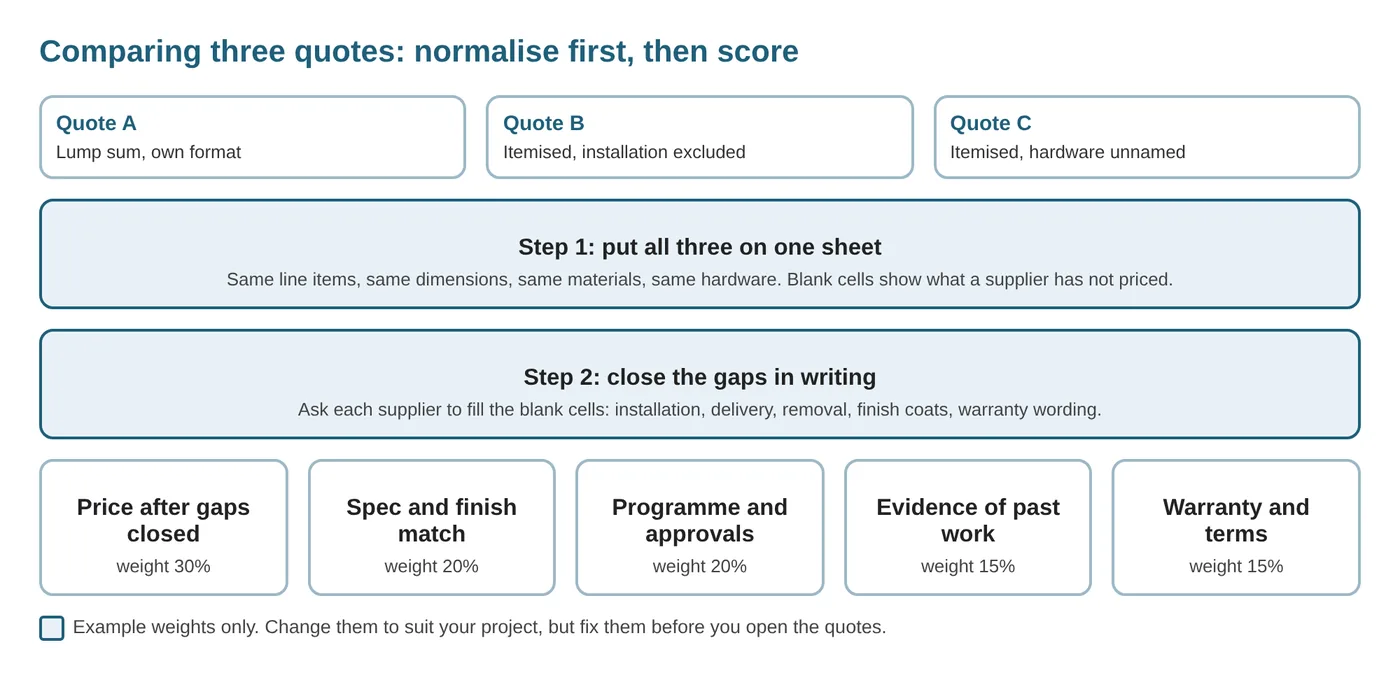
Once the gaps are closed, score each supplier against criteria you fixed in advance. The weights below are examples only. A contractor on a tight programme may weight time higher; a villa owner who plans to live in the house for 15 years may weight warranty and finish quality higher. Whatever you choose, write it down before you see the totals, because people reliably start adjusting weights once they see which supplier is winning.
| Criterion | Weight (example) | Supplier A (1-5) | Supplier B (1-5) | Supplier C (1-5) |
|---|---|---|---|---|
| Price after gaps closed | 30% | |||
| Match to your spec: board, finish, hardware | 20% | |||
| Programme and drawing-approval process | 20% | |||
| Evidence: factory visit, completed work, references | 15% | |||
| Warranty wording and aftercare | 15% | |||
| Weighted score | 100% |
A practical rule: if the lowest quote is more than about 15 to 20 percent under the others, assume a scope gap until proven otherwise. That is a rule of thumb from experience, not a law, but in most cases it holds and the gap turns out to be hardware, finish coats, or installation.
How are payments usually structured?
Payment terms vary by supplier and by project, so treat the structure below as an explanation of the logic rather than a standard. The principle is that money moves when a defined event happens, and the supplier carries real cost at each stage, so the stages should roughly match that cost.
| Stage | Event that triggers it | Why it exists | What to check |
|---|---|---|---|
| Advance | Quote accepted and scope signed | Covers survey, drawings and reserving production slot | That it is refundable in part if you cancel before drawings |
| Materials | Drawings and samples approved | Board and hardware are ordered, often non-returnable once cut | That the approval is signed by both sides |
| Pre-delivery | Manufacture complete and inspected | Supplier has carried the full production cost | That you can inspect before paying |
| Handover | Installation complete and snag list cleared | Gives you leverage for finishing details | A retention for defects period, if agreed |
Be wary of any structure that asks for a large payment before drawings are approved, and equally wary of a plan that leaves nothing until after installation. A supplier who carries the entire cost of your job will either decline it or recover that risk somewhere in the specification. Fair terms protect both sides. Contact NBELCO for rates and terms specific to your project.
What happens when you change something after signing?
Changes are normal. Clients move sockets, decide the island needs a second drawer bank, discover the fridge is 20 mm wider than the one on the drawing. What separates a smooth project from a bitter one is whether the change is handled on paper or by a phone call.
- Ask the supplier for a written variation (change order) form before you sign the contract, so you know the process in advance.
- Every variation should state what changes, the cost effect, the time effect, and who authorised it.
- A change after production has started is usually more expensive than the same change before drawings are signed, because cut parts cannot go back into the board.
- Agree who may instruct changes on your side. On a contractor job, that is a single named person, not everyone on site.
- If a variation affects the delivery date, the revised date goes on the same form.
When someone says the change is small and they will sort it out, ask for it in writing anyway. Three months later, nobody remembers which socket moved.
Is your site ready for joinery installation?
Installation is where a good quote can still go wrong. Joinery needs a finished room to go into, and much of the delay that gets blamed on the manufacturer is a site that was not ready. Go through this list before the delivery date is confirmed, and again two days before the truck is due.
- Wet trades are finished and dry: plaster, screed, tiling and waterproofing have cured. Fresh moisture is bad for board and finishes.
- Walls are plumb and floors level to within a tolerance you have agreed; large deviations are reported before drawings, not after.
- Ceiling height and any bulkheads are final and as drawn.
- Electrical first-fix and plumbing first-fix are complete, with socket, switch and water positions marked and confirmed against the shop drawings.
- Air-conditioning ducts, diffusers and any recessed items are in their final positions.
- Floor protection is down, and permanent flooring is complete if units sit on it.
- Lift booking, parking and loading access are arranged, with building management permission for working hours.
- A lockable storage space exists for delivered units if installation does not start the same day.
- Temporary power and lighting are available for installers.
- Someone with authority to accept or reject the work will be on site on the first day.
How does the drawing approval workflow work?
In custom joinery the shop drawing is the real contract. The quotation says what you will get in general; the signed shop drawing says it in millimetres. Production should not start until you have signed it, and the quote should say so.
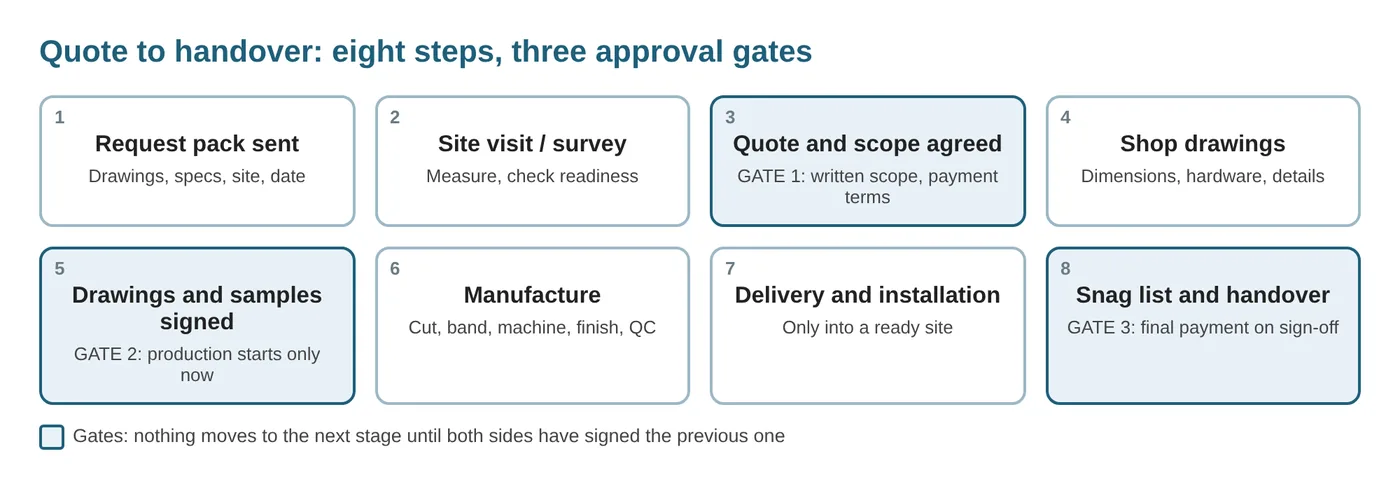
A typical workflow runs like this. After the survey, the supplier prepares shop drawings: plans, elevations and sections with sizes, door swing, hardware positions, finishes and interfaces with other trades. You, or your consultant, review them and mark up changes. The supplier revises and reissues. This can happen two or three times on a complex kitchen. When both sides sign, the drawing set is frozen, and anything after that goes through the variation procedure above.
What to look for when you review drawings: appliance sizes and ventilation gaps, whether handles clash with adjacent doors, whether drawers can open fully without hitting a wall or another unit, how filler panels are placed, and whether the finish and edge details match your samples. Most expensive mistakes in joinery are visible on the drawing for anyone who looks, and invisible once the board is cut.
How does joinery lead time really add up?
When a supplier says six to eight weeks, ask where that number starts and what it contains. In a well-run job the factory time is only part of it. The stretches that people forget are the ones where nobody at the factory is working because the job is waiting for you.
| Stage | Who holds the clock | Where time hides |
|---|---|---|
| Quote and scope agreement | You and the supplier | Missing information, comparing suppliers, internal approvals |
| Survey and shop drawings | Supplier, then you | Each review round waits for your reply; a week of silence is a week lost |
| Samples and finish approval | You | Colour decisions made late; finish samples that need re-making |
| Material ordering | Supplier | Imported boards, special veneers or hardware with their own shipping time |
| Production | Supplier | Queue position, finishing and curing time, quality check |
| Delivery | Supplier and building | Lift booking, access permits, site not ready to receive |
| Installation and snagging | Supplier and you | Late site readiness, other trades in the same room, snag rework |
A good supplier will give you a programme counted from signed drawings and will show which stages depend on your decisions. A supplier who promises a date measured from the day you accept the quote has either not thought about drawing approval or is planning not to wait for it. NBELCO's typical turnaround for a project of your size depends on scope and current workload; [To add: NBELCO typical quote turnaround and production lead-time ranges by project type].
What are the red flags in a joinery quotation?
- A single lump sum for the whole job with no breakdown, especially if the supplier refuses to itemise on request.
- No board, finish or hardware specification, only words like premium or high quality.
- No mention of shop drawings or approval before production.
- Installation neither included nor excluded. Silence usually means excluded.
- A large advance demanded before drawings, or a request to pay into a personal account.
- A delivery date that is far shorter than the other suppliers, with no explanation of how.
- A price that falls sharply the moment you hesitate. If a margin can drop that fast, it was not a calculated price.
- No factory, no completed work to show, or references that cannot be contacted.
- A warranty described as lifetime without any written terms.
What should you ask on a factory visit?
A visit tells you more than a brochure. You are not inspecting the machines for their own sake; you are looking at how the shop manages a job from drawing to finished unit. Take this list and write the answers down.
- Can you see jobs in progress with tags or drawings attached to the parts?
- How are cut parts labelled, stored and protected from damage and moisture?
- Which edge-banding method is used on visible edges and how is edge quality checked? Look at several edges closely for gaps, glue lines and chipped corners.
- Is there a separate finishing area, and how are dust and humidity controlled for lacquered work?
- Who checks a unit before it is packed, and what do they check against?
- How are units packed for transport, and who handles them on site?
- Does the installation team belong to the company or is it subcontracted?
- Can they show a finished project of similar type and let you speak to the client?
- How do they handle a defect found after handover, and who do you call?
Two things worth watching for. First, a tidy shop floor with parts labelled by job is a good sign that drawings are controlled. Second, listen to how the person showing you around talks about a job that went wrong. Everyone has them, and an honest account of what happened is a better reference than a spotless portfolio.
Is a quote for a contractor different from a quote for a homeowner?
Yes, and it matters if you wear both hats at different times. A joinery contractor in Saudi Arabia may price a package to a main contractor against a tender specification, while a villa owner is dealing directly and deciding finishes as the job goes.
| Topic | Direct client (owner) | Main contractor or developer |
|---|---|---|
| Basis of quote | Your drawings, design references and site survey | Tender drawings, specification and a bill of quantities |
| Decisions | Finishes and layout often decided during drawings | Finishes fixed by consultant specification; submittals for approval |
| Approvals | You sign shop drawings yourself | Consultant and client review through a formal submittal route, which can add weeks |
| Payment | Milestones agreed with the supplier | Often follows the main contract terms and may include retention |
| Programme | Flexible, driven by your move-in | Tied to the construction programme and other trades |
| Risk | Mostly about specification and installation quality | Mostly about coordination, access and site readiness |
| What helps the supplier | Photos, a clear brief and one decision-maker | Complete tender package, named contacts and the programme |
If you are a contractor, tell the supplier early which submittal route applies and how long review usually takes, because it changes the realistic delivery date. If you are an owner, name a single person who can decide, because a family of five opinions on handle colour costs more than any hardware upgrade.
Kitchen and wardrobe quotation: what to specify for each
Kitchens and wardrobes are the two requests that arrive most often, and each has points that decide the price and the quality. These are the details worth putting in your request, since they are the ones people tend to leave out.
| Kitchen quotation | Wardrobe quotation | |
|---|---|---|
| Carcass | Moisture-resistant core, sealed edges at the sink area | Standard core usually acceptable in dry rooms |
| Hardware | Hinges, drawer runners, bin systems, corner solutions, lifting flaps | Hinges or sliding track, internal drawer runners, hanging rails, lighting |
| Finish | Wipeable face finish, edge protection near water and heat | Matching interior finish, softer look inside |
| Interfaces | Appliances, hood, sink, counter-top, splashback, services | Ceiling height, skirting, bulkheads, nearby doors |
| Typical exclusions | Counter-top, appliances, plumbing, electrical | Internal lighting wiring, mirrors, wall repairs |
| Common surprise | Appliance dimensions that differ from the drawing | Door swing clashing with a bedroom door or window |
Frequently asked questions
How much does custom joinery cost in Riyadh?
It depends on the board, finish, hardware, geometry, quantity and site conditions. Because these vary so much, NBELCO prices each project from your drawings or measurements rather than from a published rate. Contact us for rates on your scope.
What is the price per square metre for joinery?
There is no useful single figure. A flat wardrobe and a curved reception desk of the same area are different jobs. Ask suppliers to itemise by unit and state the specification, then compare line by line.
Can I get a joinery quote from photos and a WhatsApp message?
You can get a rough budget idea, but not an accurate quotation. The supplier needs dimensions or drawings, finishes and hardware, and ideally a site survey.
Does the quote include installation?
Not always. Some suppliers price manufacture and delivery only. Ask for installation as a separate line so you can see it, and check whether adjustment and sealing are covered.
How long does it take to receive a quotation?
With a complete pack the supplier can usually quote faster, because there are fewer questions to ask. Missing details are the usual reason for delay. [To add: NBELCO standard quotation turnaround].
Why is one quote much cheaper than the others?
Most often because something is left out: installation, a hardware tier, finish coats, or delivery. Put the quotes into one table and ask the cheap supplier to complete the blank cells before you decide.
When should I pay the advance?
After the scope is agreed in writing and the payment milestones are on the quote. Be cautious about paying a large sum before drawings are approved.
Do you work with contractors and developers as well as homeowners?
Yes. NBELCO supplies villa owners, contractors and developers. For tender work, send the drawings, specification and programme so the quotation matches the submittal route.
Read next
- How a joinery and fit-out project runs in Riyadh, from quote to handover
- Arabic guide: how a woodwork factory in Riyadh works
- Arabic guide: common mistakes when ordering a custom kitchen
- Arabic guide: wall cladding and wood ceilings
NGIC delivers customized woodwork, bespoke furniture, and complete interior fit-out solutions — combining design, manufacturing, technology, and execution under one roof.
Author: [To add: author name and role]. Reviewed by the NBELCO production team.